Pension Contributions During Maternity Leave: A Practical Guide for Employers and Payroll Teams
Pension treatment during maternity leave is a frequent source of queries and potential payroll errors. The rules combine employment law protections, auto-enrolment duties and the terms of the pension scheme itself. Correct application protects employees’ pension rights and reduces compliance risk for employers.
Statutory Maternity Leave lasts up to 52 weeks and is divided into two periods:
- Ordinary Maternity Leave (OML) – the first 26 weeks
- Additional Maternity Leave (AML) – the following 26 weeks
The rules for pension contributions differ depending on whether the leave is paid or unpaid.
Summary of contribution requirements
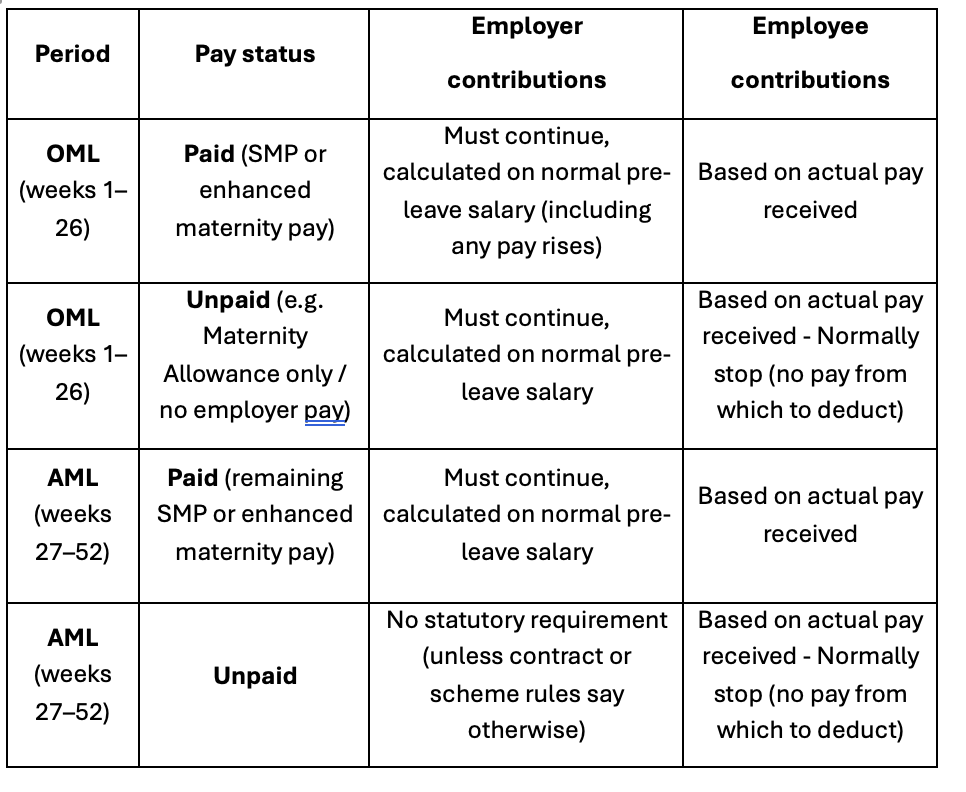
In all paid periods, active membership of the pension scheme continues. Employer contributions are never reduced to reflect the lower amount of Statutory Maternity Pay or enhanced maternity pay.
Salary sacrifice arrangements
Where the pension operates under salary sacrifice, the position is slightly different because the arrangement is contractual:
- The employer must continue to fund the full post-sacrifice contribution based on the employee’s notional (pre-leave) salary throughout OML and any paid AML.
- When actual pay is low or nil, the salary sacrifice itself is suspended so that statutory payments are not reduced. The employer still meets the full contribution that would otherwise have been made under the sacrifice.
- There is no statutory obligation to maintain the sacrifice or the associated contributions during unpaid AML, unless the contract or scheme rules require it. Most arrangements pause at this point.
Payroll teams should continue to report notional pay and the full employer-funded contribution for the protected periods so that pension records remain accurate.
Practical steps for employers and payroll teams
- Review the pension scheme rules and any salary-sacrifice agreement – these can be more generous than the statutory minimum.
- Ensure maternity policies clearly distinguish between OML and AML and between paid and unpaid periods.
- Calculate all employer contributions on the normal pre-leave salary for OML and any paid AML.
- Base employee contributions strictly on actual pay received.
- Document the treatment for employees receiving Maternity Allowance only, as this is a common query.
- Keep clear records of notional pay and contributions paid during leave.
Applying these rules correctly ensures employees continue to build pension benefits during maternity leave and helps avoid later disputes. Always cross-check the specific wording of your scheme and seek specialist advice if the arrangement is complex.